"WHAT THIS GENTLEMAN TELLS ME MATTERS ABSOLUTELY NOT AT ALL TO ME"
Apolozan case · ERDF fraud (Bilbao / Alicante / EU)
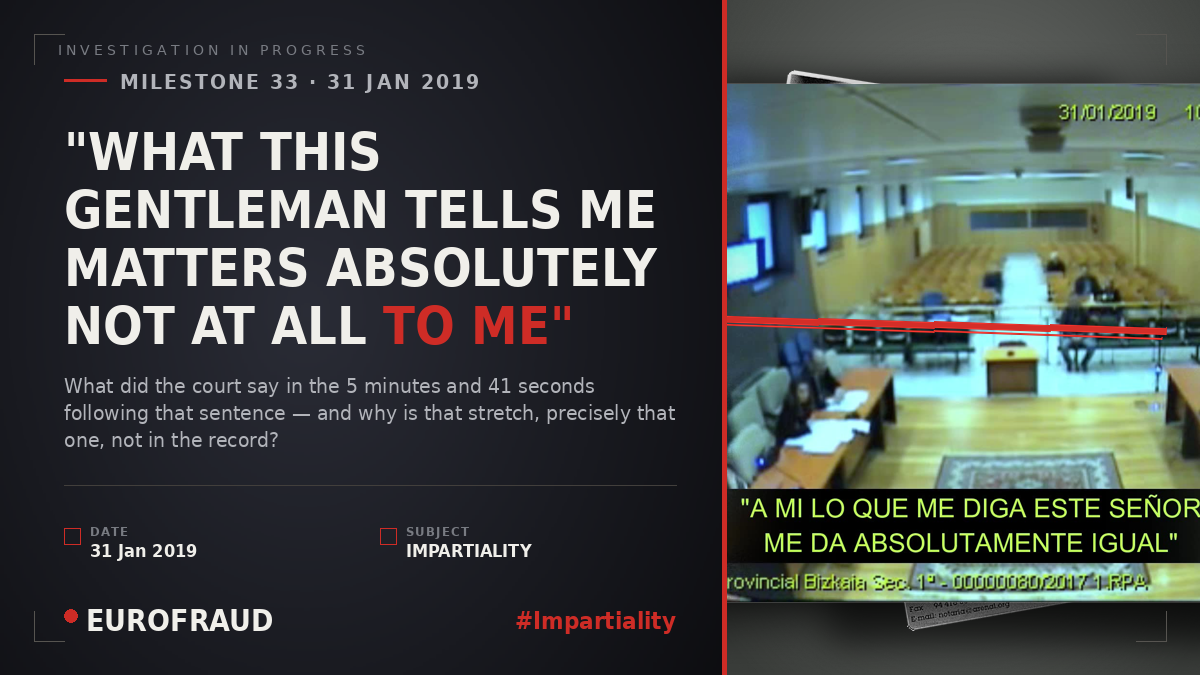
Minute 13:37 of the first block of the official recording — around 10:22 in the morning. The defence lawyer is conveying to the court what his client indicates to him about a page of the file: "Of course. What he tells me is that, according to what is on the page…". And from the bench comes the reply, recorded forever in the audiovisual record of the proceedings:
"What this gentleman tells me matters absolutely not at all to me. I have understood you perfectly well as counsel."
"This gentleman" is the accused. The man whose liberty was being decided in that room. The sentence is not a party's reconstruction or a self-serving memory: it is on the official medium, transcribed in this portal, and anyone can listen to it.
A criminal trial rests on a premise that admits no exceptions: the court listens before deciding. The right to be heard is not a courtesy — it is Article 24 of the Constitution and Article 6 of the European Convention. When a judge verbalises, in the very midst of taking evidence, that what the accused says matters "absolutely not at all", the appearance of impartiality — the one European case-law considers as essential as impartiality itself — is compromised in the record.
And now, the fact that turns the sentence into a pattern: the recording of that block is interrupted 41 seconds later. The medium does not resume until 5 minutes and 41 seconds afterwards. What was said in that gap, immediately after the sentence, does not exist for history.
EuroFraud case file · every statement links to its document (A.X / DOC-XXXX). Evidentiary material; every person named is presumed innocent.